
Prevent
Risk assessment software
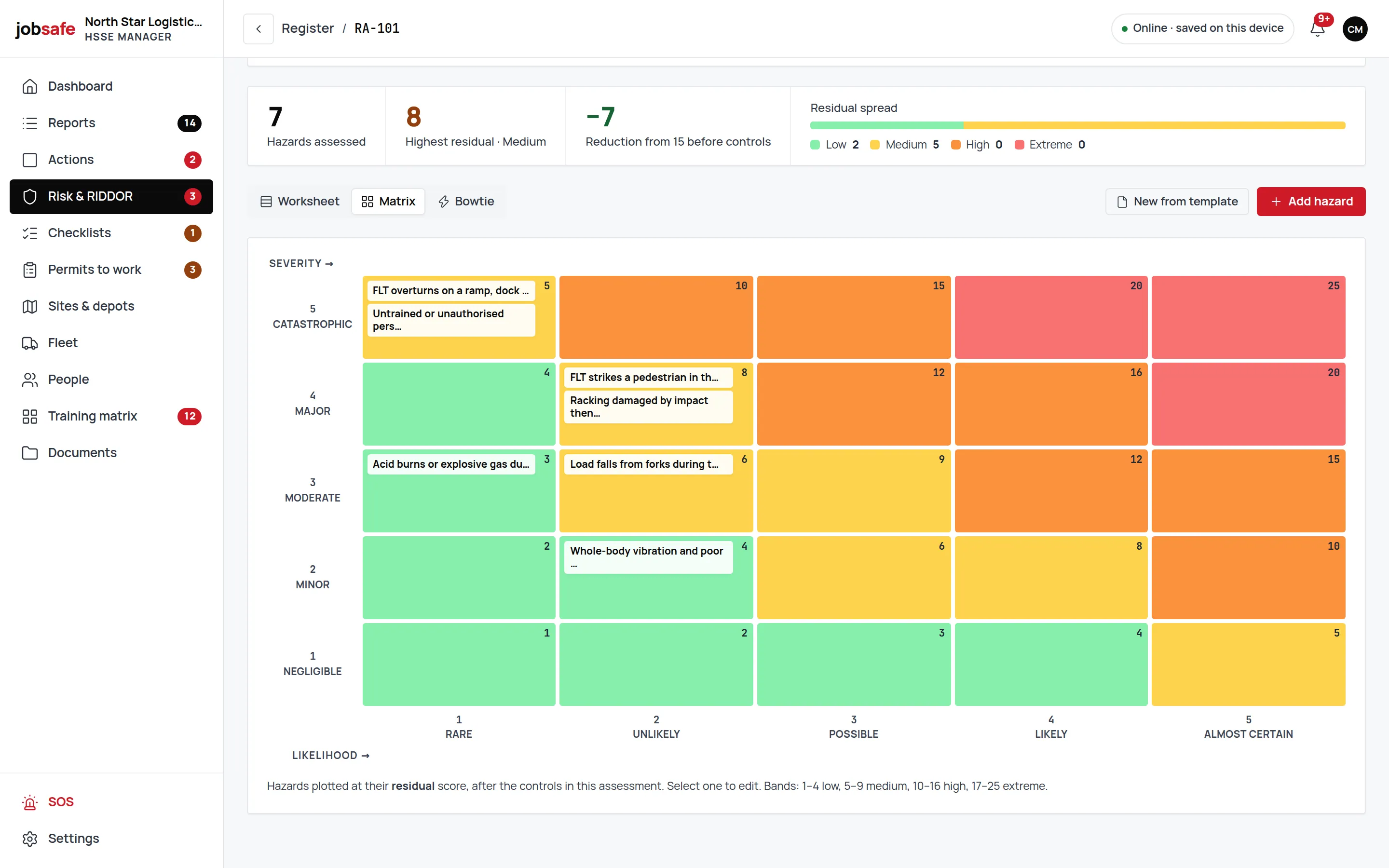
Scored on a 5×5, controlled by hierarchy, approved before it goes live.
Risk assessment software with six types (general, COSHH, fire, DSE, manual handling and bespoke), 5×5 likelihood × severity scoring with named bands, 16 hazard categories, 10 at-risk groups, controls tagged by hierarchy of control with an owner and a due date, a “suitable and sufficient” check under MHSWR 1999 reg 3, and a bowtie view for the risks that deserve one.
- 5×5 scoring with named bands
- Six assessment types
- Hierarchy of control
- MHSWR reg 3 suitability check
- Bowtie analysis
The problem, then the record
Three things that go wrong on paper
On paper
A risk assessment written for the audit, not the job, sits in a folder unread.
With jobsafe
Eight templates start you from the real work (forklift operations, yard traffic segregation, manual handling, roof access, COSHH drum wash, fire, lone working night trunking, DSE), and the lifecycle puts a review date on it.
On paper
Controls are listed, but nobody owns them and nobody knows if they are “existing” or “planned”.
With jobsafe
Existing and further controls are tagged by hierarchy of control from Eliminate to PPE, each with an owner and a due date, and further controls raise actions.
On paper
An inspector asks whether the assessment is suitable and sufficient. Nobody is sure.
With jobsafe
The suitability check warns when an assessment is not yet suitable and sufficient under MHSWR 1999 reg 3, before it can be approved.
The worksheet: hazards, people, controls, score
16 hazard categories and 10 at-risk groups, including young persons, new and expectant mothers, and lone workers. Likelihood × severity on a 5×5: Low 1–4 “broadly acceptable”, Medium 5–9 “reduce where reasonably practicable”, High 10–16 “must be reduced” with a 30-day deadline, Extreme 17–25 “STOP the activity”.
- Hierarchy of control
- Eliminate, substitute, engineering, administrative, PPE, on every control.
- At-risk groups
- Ten groups, so the young person and the lone worker are not an afterthought.
- Actions from hazards
- A further control becomes an action with an owner and a date.
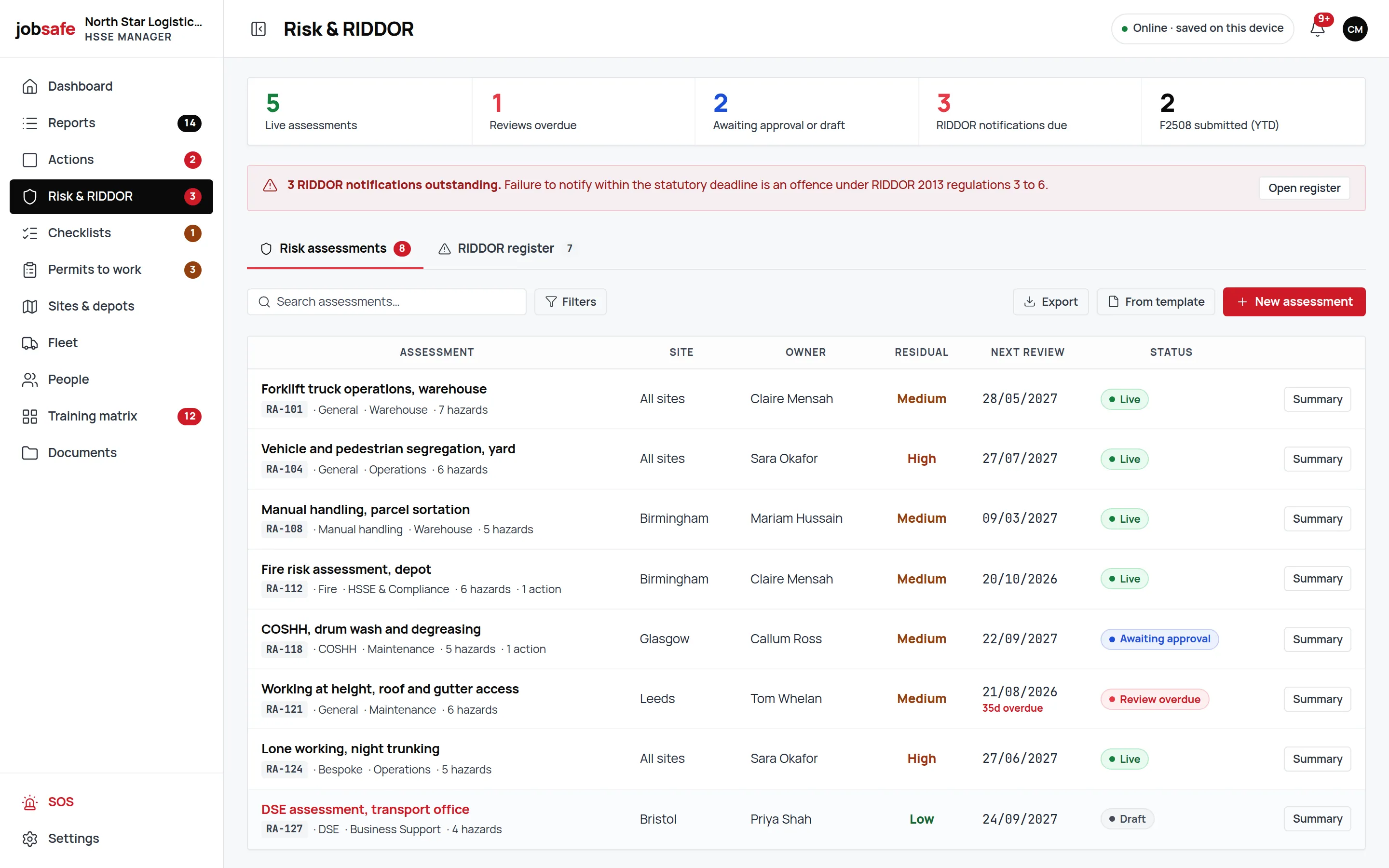
Draft, approve, live, review
Draft → Awaiting approval → Live → Review overdue. Only a Live assessment can support a permit, and a High score sets a 30-day deadline to bring it down.
- Approval before live
- The suitability check runs before the approver sees it.
- Review overdue
- The register shows what has lapsed, so the review date means something.
- Feeds the permit gate
- Permits to work require a Live supporting risk assessment.
Bowtie, for the risks that can kill
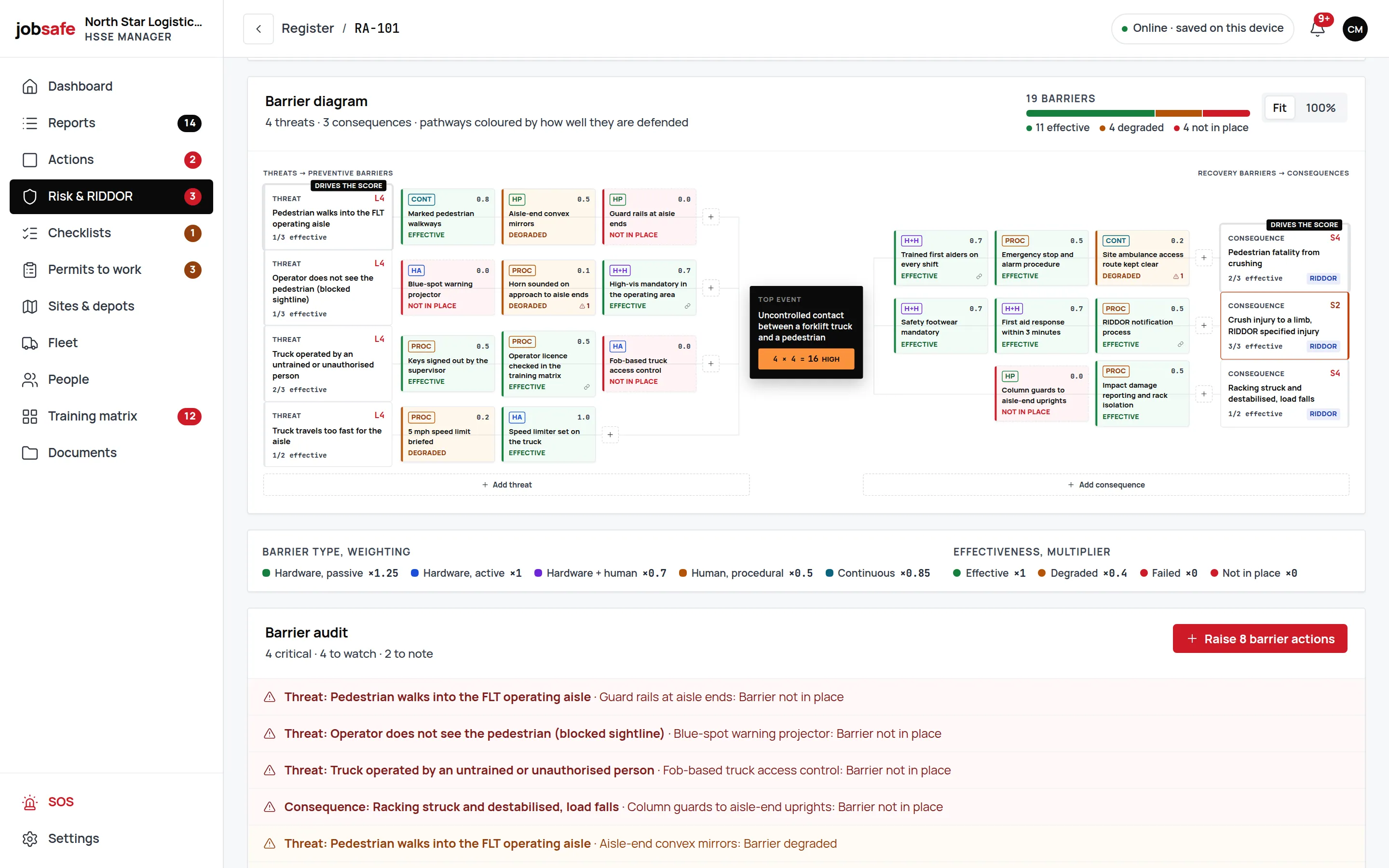
Threats on the left, consequences on the right, barriers between. Barrier types: passive hardware, active hardware, hardware plus human, human procedural, continuous. Effectiveness: Effective, Degraded, Failed or Missing. Escalation factors on any barrier. A computed score you can adopt into the worksheet, and a barrier audit that flags a leg with a single barrier.
- Barrier effectiveness
- Effective, Degraded, Failed or Missing, for each barrier.
- Barrier audit
- Any threat or consequence leg protected by one barrier is flagged.
- Adopt the score
- The bowtie’s computed score can replace the worksheet’s.
Connected to
Where this record goes next
Every module writes to the same record, so what happens here shows up in these.
- Permits to workSix permit types that will not issue until the contractor and the risk assessment check out.
- Corrective actionsRaised from reports, hazards, checklists and permits, each with an owner and a date.Page coming in a later phase.
- Incident & near-miss reportingSeven steps from any phone, with photos, GPS, people, vehicles and RIDDOR triage.
- Training & competenceA competency matrix that shows who is in date for what.Page coming in a later phase.
UK regulation
MHSWR 1999 reg 3 and the rest
Regulation 3 of the Management of Health and Safety at Work Regulations 1999 requires every employer to make a suitable and sufficient assessment of the risks to employees and to others affected by the work, and to record the significant findings where five or more people are employed. COSHH 2002, the Regulatory Reform (Fire Safety) Order 2005 and the DSE Regulations 1992 each call for their own assessment.
jobsafe gives each of those an assessment type and a template, checks suitability before approval and keeps the record with its review date. It does not certify anything: the assessment is yours, and so is the judgement in it.
jobsafe holds no certification and claims none. The records are yours; so is the judgement in them.
FAQ
Frequently asked questions
Straight answers about risk assessments & bowtie in jobsafe.
The one your supervisors will actually use on a Tuesday: scored the way HSE describes (likelihood × severity), with controls that have owners, an approval step and a review date that is enforced. jobsafe does that with a 5×5 matrix, hierarchy of control, six assessment types and a bowtie view, and it works offline.
Yes. The law asks for a competent person, not a consultant; if you know the work and the hazards, you are that person. jobsafe gives you templates for common jobs, a 5×5 matrix with named bands and a check that the assessment is suitable and sufficient before it is approved.
General, COSHH, fire, DSE, manual handling and bespoke, each with its own template.
A diagram with the top event in the middle, threats on the left, consequences on the right and the barriers between them. It shows which single barrier you are relying on. jobsafe’s bowtie view scores it and audits the barriers.
High (10–16) means the risk must be reduced and sets a 30-day deadline. Extreme (17–25) means stop the activity.
Yes. Assessments save to the device first and sync when signal returns, like every module.
See risk assessments & bowtie on your own setup.
A 30-minute walkthrough with someone who knows the product, on a UK haulier’s data.